You want a golden saree photo with a soft motion blur background. Here is the first prompt, the one I tested on both tools.
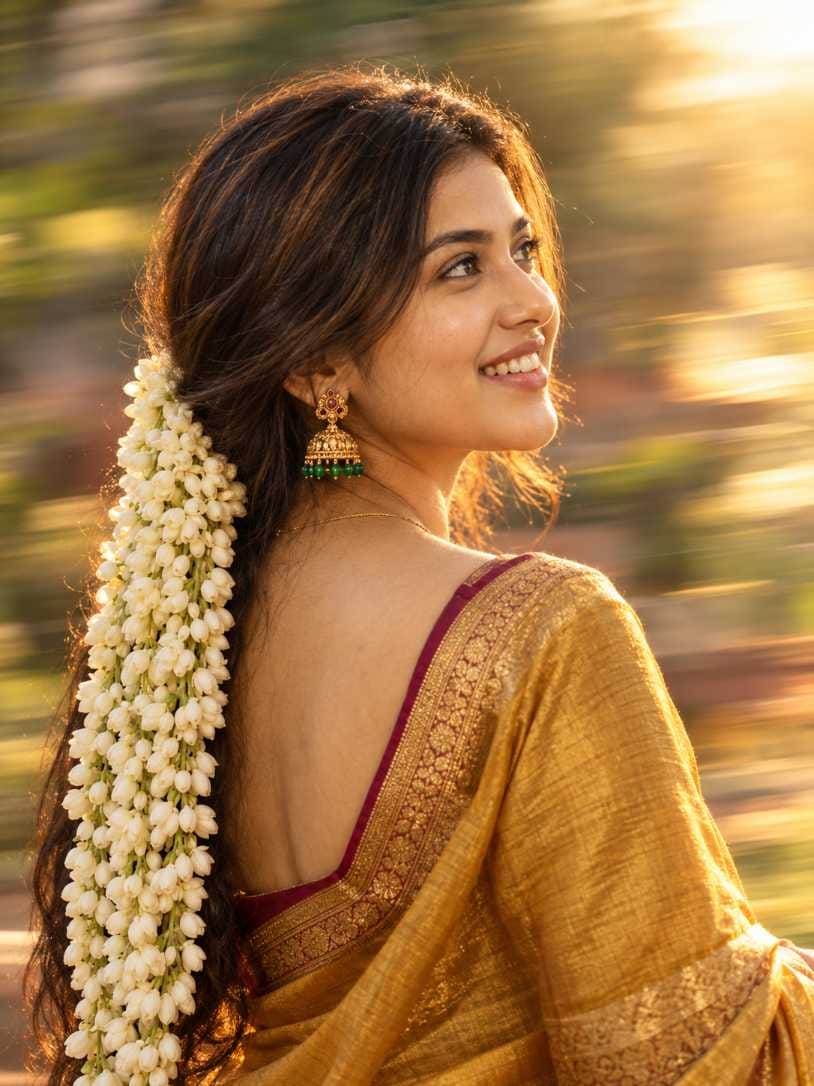
IMAGE 1: Woman seen from the back and side, head turned in profile, mustard-gold silk saree, jasmine garland, golden-hour garden streaked with gold and green
This one is a back three-quarter pose with the head turned to the side. The second prompt is different. It’s a seated night scene with a lowered gaze and crossed hands.
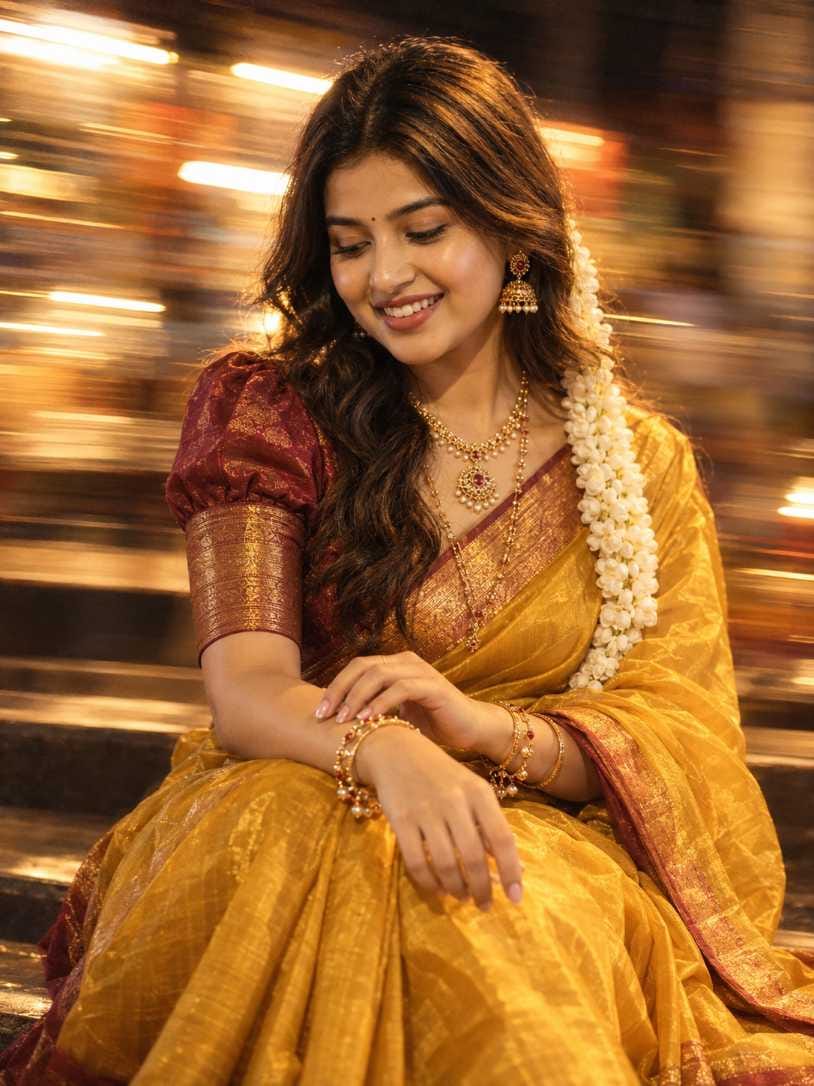
IMAGE 2: Smiling woman seated, head tilted down, hands crossed near a bracelet, mustard-yellow saree, rose-maroon blouse, dark warm night background with amber light streaks
⫷RonyTica Prompt Box
This is a PHOTO EDIT of the attached photo of me, not a new image of a similar-looking person. The result must look like a real photograph of exactly me. Treat my photo as the ground truth for my face. Preserve exactly: face shape and proportions, jawline and chin, cheek fullness, forehead, nose shape, eye shape and spacing, eyebrows, lip shape, ears, skin tone and natural skin texture, facial hair density and shape, and apparent age. Do NOT slim, sharpen, smooth, beautify, retouch, de-age or idealize my face, and do not blend in features from any other person or reference image. Change only what is listed in the scene below. Keep my own hair color, hairline and beard exactly as they really are (use my photo as the guide) and do not copy hair from any reference image.
SCENE TO CREATE:
A vertical portrait photograph shot from behind and slightly to the side, in a three-quarter back view. The subject’s torso is turned away from the camera at roughly 45 to 60 degrees, and the head is turned in clean profile toward the right side of the frame. The chin is lifted slightly and the gaze goes off-frame to the right and a little upward, in a calm, contemplative, distant manner. The shoulders are relaxed and the neck is elongated. The framing is a medium close-up from the upper back to just above the crown, with the subject filling most of the frame. The camera sits at about eye level to slightly below, and the subject occupies the center and right of the composition.
The shot looks like a deliberate slow-shutter or panning-style capture, around 1/15 to 1/30 second. The subject is relatively sharp, especially the earring, the neckline trim and the textured edges, while the whole background and the outer edges of the frame are dragged into long horizontal streaks of motion blur. These streaks run left to right across the image and look like glowing light trails, with a few ghosting trails near the shoulder and edges. The effect is a lens like an 85mm f/2 or a 50mm f/1.8 with a shallow depth of field, so the background melts into creamy abstract bands of gold, amber, olive green and soft brown.
The outfit is a traditional South Indian style silk saree and blouse in a rich mustard-gold, almost antique-gold, color with a fine tissue-like, lightly metallic sheen and soft folds that catch the light. The neckline has a narrow, ornate gold zari border with delicate woven patterns. A deep magenta-maroon or wine-colored inner layer or blouse edge peeks out near the shoulder and back of the neck. A thin gold chain with a fine linked texture runs along the neck. The main accessory is a traditional gold jhumka (temple-style bell-shaped earring) with a filigree top, tiny red and pink stones, and a row of deep emerald-green bead drops along the bottom edge. Along the length of the back runs a long, thick garland of fresh white jasmine buds, gajra-style, densely packed and slightly cascading, with creamy ivory petals and small touches of green stem. It adds a strong vertical white accent to the composition.
The background is an outdoor, blurred natural setting, probably a garden or courtyard at golden hour. It is entirely abstracted by motion blur into warm horizontal bands of honey, amber, soft green and dusty brown, with no recognizable props. The background must contain no text, letters, captions, logos, watermarks, or typography of any kind.
The lighting is warm, low-angle golden-hour sunlight from the right and slightly behind the subject. It creates a glowing rim light along the profile edge, the neck and the fine wispy strands at the edge of the silhouette, with a soft backlit halo. Fill is gentle, from ambient bounce, so the shadows on the back stay soft, rich and dimensional, not harsh. The color temperature is warm, around 3500 to 4500K, with a sunlit glow and gentle contrast. The palette is dominated by mustard gold, amber, warm cream, deep magenta accents, emerald green accents and white jasmine. The grading is cinematic and warm, with slightly lifted blacks, honeyed highlights, gently saturated golds and a subtle film-like glow and fine grain.
The mood is nostalgic, serene, romantic and traditional, with a feeling of movement and fleeting time. The overall style is an editorial, fine-art cultural portrait that mixes a motion-blur experimental look with a refined, festive South Indian aesthetic.
Suggested aspect ratio: 3:4 vertical (portrait), or 4:5 for social media.
Photorealistic, natural skin texture with visible pores, no plastic or airbrushed look, no face-swap look. If anything in the scene conflicts with how my real face looks, my real face wins.
IMPORTANT: Do not add any text, script, captions, symbols, logos, watermarks, or typography anywhere in the image. Output a single image.
⫷RonyTica Prompt Box
This is a PHOTO EDIT of the attached photo of me, not a new image of a similar-looking person. The result must look like a real photograph of exactly me. Treat my photo as the ground truth for my face. Preserve exactly: face shape and proportions, jawline and chin, cheek fullness, forehead, nose shape, eye shape and spacing, eyebrows, lip shape, ears, skin tone and natural skin texture, facial hair density and shape, and apparent age. Do NOT slim, sharpen, smooth, beautify, retouch, de-age or idealize my face, and do not blend in features from any other person or reference image. Change only what is listed in the scene below. Keep my own hair color, hairline and beard exactly as they really are (use my photo as the guide) and do not copy hair from any reference image.
SCENE TO CREATE:
A portrait-orientation, three-quarter-length shot of a seated subject, framed from slightly above chest height and a little off-center, so the upper body, both forearms and the lap fill the frame. The body is angled gently toward the camera with the shoulders relaxed and slightly turned. The head is tilted down and slightly to the side, with the gaze lowered toward the hands in a quiet, introspective moment. The arms cross in front of the torso. One hand rests across the opposite wrist as if checking a watch or adjusting a bracelet, with the fingers softly curved and relaxed. The other hand hangs loosely below, palm angled inward, and the fingertips carry a pale nude-pink manicure.
The camera uses a wide to standard lens, roughly 28 to 35mm equivalent, at close range. The style is a deliberate slow-shutter motion blur combined with a flash or continuous light. The subject stays relatively sharp, especially the hands, jewelry and upper chest, while the surroundings smear into long horizontal streaks, as if the camera was panned or dragged sideways during a long exposure. Some soft ghosting trails around the edges of the figure, and the depth of field is shallow, with the background fully abstracted.
The outfit is traditional South Asian festive wear. The blouse is a rich rose-maroon silk with a shimmering, crinkled, metallic tissue-like texture and fine gold zari borders at the sleeve edges and neckline. The sleeves are short and puffed, ending just above the elbow. The drape is a saturated mustard-yellow saree in a soft silk or satin with gentle folds pooling across the lap. A long strand of white jasmine flowers, in a thick garland with petals blurred by motion, falls forward over one shoulder and runs down the front of the body.
The jewelry is antique gold temple-style. It includes a layered necklace set with a large ornate pendant at the center, studded with red and ruby-like stones and hanging pearl drops, plus a longer chain with a delicate beaded or filigree pattern. Jhumka-style drop earrings in gold with red stones and tiny pearls, a small gold nose stud or ring, and a small round bindi on the forehead complete the look. Both wrists carry thin gold bangles or bracelets with dangling charms, small bells and red and white bead accents that catch the light and swing slightly.
The background is a dark, warm interior at night, perhaps a festival hall, temple corridor or street lit by strings of lights. It breaks into long amber, golden, brown and black streaks, with a few bright white-yellow light slashes in the upper left corner. There are no readable props or details, only abstract light trails.
The lighting is a warm mix of tungsten practicals and a soft on-camera flash. The key is frontal and slightly from above, soft and glowing, and it lifts the subject out of the dark surroundings. Fill is gentle and warm, keeping the shadows amber rather than black. A faint rim of warm light from the ambient lamps outlines the shoulders and the garland. Color temperature is warm, around 3000 to 3800K.
The color palette is golden amber, honey, burnt orange, deep maroon, mustard yellow and chocolate brown, with creamy white highlights from the flowers. Grading is vintage and filmic, with lifted warm blacks, a slight haze or bloom around the highlights, soft contrast, gentle grain and a nostalgic analog look, reminiscent of a 35mm film or disposable camera photograph.
The mood is dreamy, intimate, nostalgic and festive, with a sense of movement and a fleeting moment. The overall style is editorial-meets-candid, motion-blur art portraiture with cultural elegance and a cinematic, romantic atmosphere.
Suggested aspect ratio: 3:4 portrait (or 4:5 for social media).
Photorealistic, natural skin texture with visible pores, no plastic or airbrushed look, no face-swap look. If anything in the scene conflicts with how my real face looks, my real face wins. Output a single image.
My Test Setup
I uploaded one simple photo of my model and pasted the prompt. That’s it. I used Google Gemini for most tries and ChatGPT for one try on each image. Nothing fancy.
Image 1: Face Problem and the Fix
This is where I had trouble, so let me go slowly.
The prompt for image 1 turns the head to the side. Even if your uploaded photo shows the face straight from the front, the result shows the face half turned. So the AI has to guess the side view of a face. That’s hard for it.
In my first try on Gemini, the face came out, but it had small mistakes. Not terrible. Just a bit off.
So I tried Gemini again. This time I added one line: “Don’t change my face.” The face got better. Not perfect, but better. That’s the fix I’d use first.
Then I tried ChatGPT with the same prompt. I added nothing. It showed good accuracy and made the image very nicely.
Here’s what I’d do in your place :
Upload a clear photo with the face easy to see.
Paste the prompt as it is.
If the face looks wrong, send the prompt again with “Don’t change my face” added.
Compare the two results side by side before you decide.
The prompt already tells the AI to keep your face and hair unchanged. But the side profile makes the AI drift anyway. So the extra line helps. Also, the prompt asks for a sharp person inside heavy blur. Sometimes the whole image goes soft. If that happens, lower the blur a little and try again.
Image 2: Saree Design Difference
For image 2, I uploaded the model photo, pasted the prompt in Gemini, and that was all. I picked Gemini because it’s very fast. The face was right. Everything looked fine. No mistakes.
But I was curious. So I tried ChatGPT too.
ChatGPT changed the saree. It was still yellow, but the design was a little different from what I wanted. I tested it again and again. I could not get that exact saree. So I didn’t pick the ChatGPT photo. I picked the Gemini one.
Speed: Gemini vs ChatGPT
ChatGPT took a lot of time to make the image. A lot. Gemini made both of my images much faster, even with two tries on image 1.
For face accuracy on image 1, ChatGPT did well without any extra help. For the saree on image 2, Gemini was the one that got it right. So my pick is Gemini. It’s quick, and I got the saree I wanted. Use ChatGPT when the face is your biggest worry and you don’t mind waiting.
Which Result I Picked and Why
I chose Gemini’s photo for image 2 because the saree matched and the face was clean. For image 1, I started with Gemini and fixed the face with the extra line. I’m saying it plainly: skip ChatGPT if the exact saree design matters to you.
Make It Yours: What to Change
Change this
What usually happens
Saree colour (deep green, royal blue, red)
The whole mood shifts. Bright colours pop more against the streaks.
Flowers (roses or marigolds, not jasmine)
The look gets more festive and colourful.
Light (soft morning haze or blue evening)
The warm golden feel turns cooler and calmer.
Blur amount
Light streaks look gentle. A stronger sweep looks more dramatic but can soften the person.
Jewellery (pearls or silver)
The look becomes less traditional and more modern.
Pose (looking at the camera)
Good for image 2 if you want eye contact.
Source Photo, Mistakes and Posting
Which photo to upload. Use a photo with good, even light. Keep the face clearly visible. A plain background works best. Skip heavy filters, because the AI then copies the filter look. Use a sharp photo, not a tiny or blurry one.
Common mistakes and fixes
The face doesn’t match. Add “Don’t change my face” and try again. Side profiles and tilted-down heads cause this most.
Whole image looks soft. Reduce the blur strength in the prompt.
Hands look odd in image 2. Crossed hands with many bangles confuse the AI. Try again, or change the pose so the hands are not crossed.
Saree looks different from what you asked. Run it once or twice more. If it still fails, switch the tool.
Posting on Instagram and Facebook. A single post works well for one strong image. A carousel is better when you want to show both photos together, because they look different but share the same saree theme. A reel is fine if you want to show the before photo and the AI result. For feed posts use 4:5 portrait, 1080×1350. For reels and stories use 9:16, 1080×1920.
Three captions in different voices :
Soft: “Gold light, slow wind, and one quiet smile.”
Playful: “Saree on, camera ready. The background can keep moving.”
Short and bold: “Still in the middle of all that motion.”